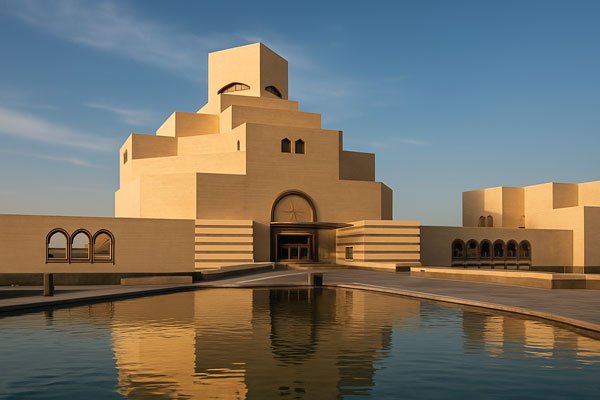
🕌 Museum of Islamic Art – The Crown Jewel of Qatar’s Culture
The Museum of Islamic Art (MIA) is more than just Qatar’s most famous cultural landmark — it is a global icon of art, architecture, and heritage. Standing alone on its own island along the shimmering waters of the Doha Corniche, MIA welcomes millions of travelers every year who come to witness its breathtaking design and its priceless collection that spans over 1,400 years of Islamic history.
Designed by the world-renowned architect I.M. Pei, the mastermind behind the Louvre Pyramid, the museum is often described as a “masterpiece housing masterpieces.” From its grand exterior to its peaceful waterfront park, every detail of MIA reflects the beauty, geometry, and spirituality of Islamic art.
Whether you are a culture lover, architecture enthusiast, historian, or traveler seeking a unique experience, the Museum of Islamic Art is the number-one attraction in Qatar that you simply cannot miss.
🌟 A Masterpiece Designed by I.M. Pei
The design journey of MIA is itself a fascinating story. At the age of 91, architect I.M. Pei came out of retirement exclusively to design this museum. Before starting the project, he spent six months traveling across the Middle East, visiting mosques and historical sites to understand the essence of Islamic architecture.
His inspiration came from the 9th-century Mosque of Ahmad Ibn Tulun in Cairo, particularly the way light hit the domed structure. He transformed this inspiration into a bold, modern interpretation of Islamic geometry.
Key architectural highlights:
-
A five-story geometric structure made of limestone
-
A grand central atrium topped with a 54-meter-tall dome
-
Floor-to-ceiling glass walls overlooking the Doha skyline
-
A floating appearance, as if rising from the Arabian Gulf
-
A grand staircase that has become one of Qatar’s most photographed interiors
The architecture alone is worth the visit, offering endless opportunities for photography and appreciation of detail.
🏛️ A Collection Spanning 1,400 Years
Inside the museum, visitors are transported through the story of Islamic civilization, from the 7th to the 20th century. MIA houses pieces from Spain, North Africa, the Arabian Peninsula, Persia, Turkey, Central Asia, India, and China, showcasing the global reach of Islamic culture.
Among the most famous pieces are:
-
Rare Qur’an manuscripts with gold calligraphy
-
Ancient ceramics from the Abbasid and Fatimid periods
-
Persian carpets and intricately woven textiles
-
Jewel-encrusted swords and royal armor
-
Ottoman glass and metalwork
-
Scientific instruments including astrolabes and early navigation tools
-
Moghul Indian jewelry studded with emeralds, rubies, and pearls
Each gallery is arranged chronologically and thematically, helping visitors understand the evolution of patterns, craftsmanship, materials, and cultural exchanges across continents.
What makes MIA special is not only the beauty of the artifacts but also the way they reveal the scientific, mathematical, and artistic achievements of Islamic civilization.
🖋️ The Art of Calligraphy – Heart of Islamic Creativity
One of the museum’s most breathtaking sections is its calligraphy collection. Islamic calligraphy is more than writing; it is a sacred art form developed over centuries, reflecting the importance of the written word in Islamic culture.
MIA showcases:
-
Qur’an pages written in Kufic script
-
Gold-illuminated manuscripts
-
Royal decrees with intricate margins
-
Calligraphic art pieces from the Ottoman Empire
-
Early Arabic papyrus documents
These works demonstrate the beauty of language and the deep cultural value placed on literacy, knowledge, and creative expression.
🕌 A Unique Journey Through Islamic Civilizations
Visitors often describe MIA as a journey — not just a museum. Each floor takes you into a different era, culture, and region. You see how Islamic art is not limited to one place or one style, but is influenced by Arabia, Persia, India, Africa, and even China.
What makes this museum truly special:
-
It shows how cultures blended and coexisted
-
It highlights Islamic contributions in science, mathematics, and craftsmanship
-
It preserves artifacts that would otherwise be lost to history
By the end of your visit, you walk away with a deeper understanding of artistic diversity, cultural connections, and the intellectual legacy of Islamic civilization.
🌅 Unmatched Views of the Doha Skyline
One of the museum’s greatest attractions is its location. MIA was built intentionally on a standalone island so that nothing could obstruct its views. From the museum’s glass-walled interior and outdoor terrace, visitors can enjoy one of the best skyline views in Doha.
The turquoise waters of the Arabian Gulf create a perfect contrast with the futuristic skyscrapers of West Bay. Many travelers visit MIA just to take photos of the skyline, especially during sunset.
Best photography spots at MIA:
-
The outdoor terrace overlooking the Corniche
-
The staircase inside the grand atrium
-
The reflecting pool at the entrance
-
The museum’s marina area
-
The MIA Park hilltop
If you love architecture and photography, this museum is paradise.
🌳 MIA Park – One of Qatar’s Most Beautiful Outdoor Spaces
Surrounding the museum is the famous MIA Park, one of the most popular public spaces in Doha. It features:
-
Beautiful walking and cycling paths
-
Outdoor art installations
-
Large green areas for families and picnics
-
A modern café with waterfront seating
-
Seasonal events, movie nights, and food festivals
The park is especially lively on weekend evenings, where families, tourists, and runners enjoy the fresh air and scenic views.
MIA Park also hosts:
-
Farmers’ markets
-
Outdoor workout sessions
-
Cultural festivals
-
National Day celebrations
-
Fireworks events
It’s a perfect place to relax before or after visiting the museum.
☕ Dining: MIA Café & Park Café
For food lovers, MIA offers two main dining options:
1. MIA Café (inside the museum)
-
Modern interiors
-
Panoramic skyline view
-
A menu featuring pastries, desserts, sandwiches, and coffee
2. Park Café (in MIA Park)
-
Outdoor waterfront seating
-
Mediterranean-inspired menu
-
Popular with families and tourists
Both cafés are known for their relaxing atmosphere and great views.
🎭 Events, Workshops & Cultural Programs
MIA is not just a museum — it is a vibrant cultural center. The museum regularly hosts:
-
Art workshops
-
Cultural lectures
-
Film screenings
-
Temporary exhibitions
-
Family activities
-
School programs
-
International guest exhibitions
These events help connect people with Islamic art in creative ways.
🧭 Visitor Information (Useful for Tourists)
Tickets & Entry:
Most exhibitions and museum entry are free, but special exhibitions may require a ticket.
Opening Hours:
Hours may change seasonally or during Ramadan, but generally:
-
Saturday–Thursday: 9 AM – 7 PM
-
Friday: 1:30 PM – 7 PM
Location:
Doha Corniche, easily accessible by car, taxi, or metro (via National Museum or Souq Waqif stations + short taxi ride).
Best Time to Visit:
-
Late afternoon for cooler weather
-
Sunset for photography
-
Weekdays for a peaceful visit
🌍 Why the Museum of Islamic Art Is a Must-Visit Destination
The Museum of Islamic Art is the cultural heart of Qatar. It offers:
-
World-class architecture
-
Priceless historical treasures
-
Deep cultural insights
-
Amazing skyline views
-
A beautiful surrounding park
-
Activities for families, students, and tourists
Whether you visit for 1 hour or 1 full day, MIA delivers a complete experience that combines learning, art, culture, nature, and relaxation — all in one place.
It is a destination that speaks to the soul, reminding visitors of the beauty, creativity, and global influence of Islamic civilization.